‘Complementing’ Clinical Practice with Doctoral Studies at UNCG
Enahora entered the doctoral program in 2019, with Jared McGuirt, assistant professor in the nutrition department, as her advisor. In the McGuirt lab, she said she has been “fully immersed” in the research process, including assisting with peer-reviewed manuscripts and grant-funded research.
“I’ve gotten both breadth and depth of research, which has been really interesting,” she said.
Currently, Enahora is focused more on “depth,” as she works to complete her rigorous dissertation research. Her work explores how African American adolescents perceive a virtual reality nutrition program. This topic dovetails with Enahora’s clinical practice because she had begun to notice more adolescents who were diagnosed with prediabetes seeking services.
“Adolescence is really that critical time period where they’re trying to develop autonomy and life skills” she said. “It’s also where we see the highest rate of childhood overweight and obesity, with greater disparities among minority youth.”
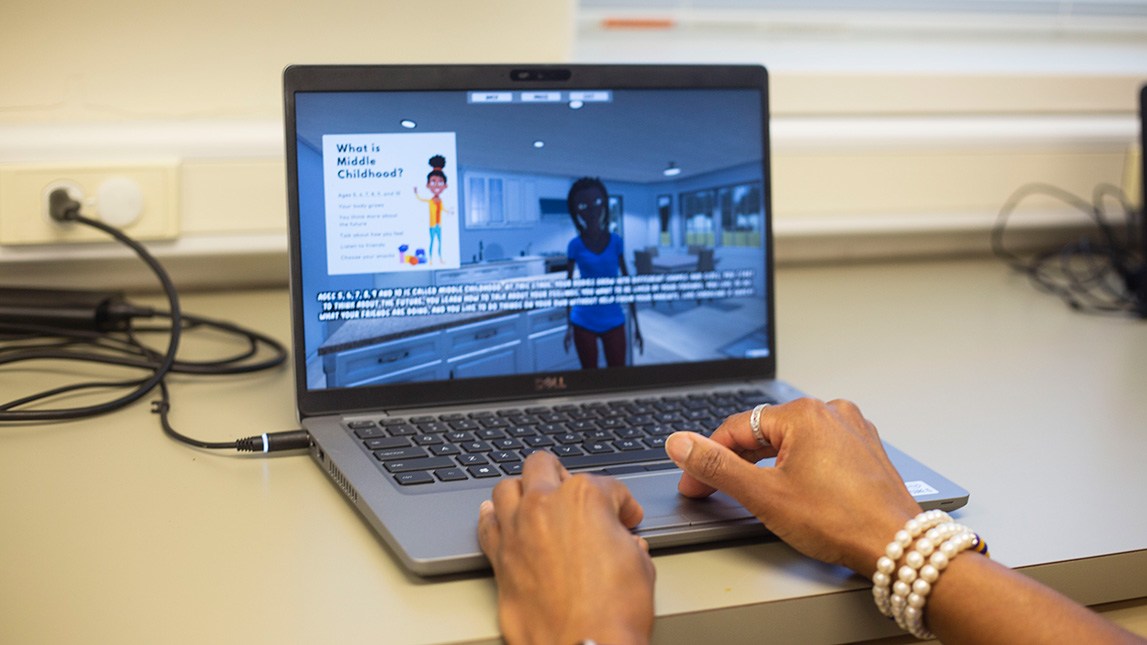
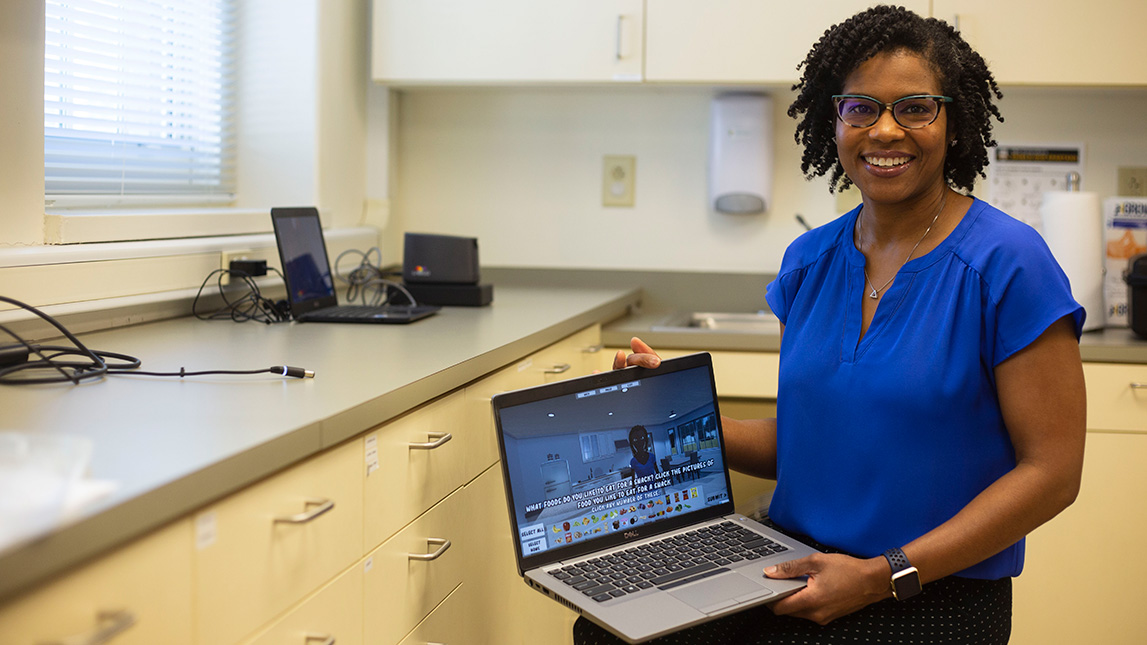
While this transitional time period is pivotal, much remains unknown about African American adolescents’ perspectives towards nutritional programs – a gap in the literature that Enahora is aiming to help fill. For her dissertation, she is assessing the appeal and adoption of a virtual reality nutrition program that the McGuirt Laboratory initially designed for children aged five to 10 years old to deliver information about “healthy eating, healthy snacking, and physical activity.”
And this isn’t a run-of-the-mill nutrition program. First, the program is customizable, Enahora explained. Adolescents can alter the appearance of the virtual agent (i.e., the avatar) that delivers the nutrition guidance.
“The avatar is kind of a virtual friend,” Enahora said. “They can make it look somewhat like themselves.”
This look-a-like avatar is also interactive. For example, when relaying information about physical activity to an adolescent, the avatar may suggest that the individual take a walk in their neighborhood or even demonstrate an exercise. Another unique feature of the program is that it can incorporate geographic information system data. If the adolescent is comfortable providing their zip code, the program can then tailor recommendations to the person’s location.
“If there aren’t a lot of grocery stores in the area, then the program will provide them with tips about what they could buy in a convenience store or what they could get from a fast-food outlet that would still be balanced,” Enahora said.

Once the avatar and adolescents’ time together has come to a close, Enahora gives them a survey to assess their attitudes towards and usage of the program. Then, Enahora conducts 24-hour dietary recalls to better understand what adolescents are eating. Finally, in a subset of youth, an objective measure of fruit and vegetable intake is obtained using an aptly named device called a Veggie Meter®. When an adolescent puts their finger in the Veggie Meter®, the device scans the skin for indicators of fruit and vegetable intake (i.e., carotenoids).
Enahora’s research extends beyond collecting this data from adolescents at the Boys & Girls Club. She is also interested in understanding how this nutrition program can be implemented in communities. Thus, for her final study, Enahora is surveying community partners, including public health programs and cooperative extension stakeholders, to learn more about how to best disseminate this program to the broader community.
She said that the long-term goal of this work is to provide information about nutrition to adolescents who may not have access to this insight otherwise – and to give them this key educational support in a way that works for them. In this way, Enahora hopes this research can help improve the lives of many individuals and break the bottleneck effect.
“In research, we can develop interventions and programs where we can affect numerous people at one time, communities at one time,” she said. “I think it just really helps to advance the practitioner’s role…and complement what’s done in practice.”
Enahora aims to continue her complimentary roles as dietitian and researcher, either as a postdoctoral associate or a faculty member once she graduates from UNCG—a place she has found warm, collegial, and “immensely helpful” to her growth as a scholar.
“I definitely find joy and passion around intervention development, particularly with youth, so I see myself focusing on that in the future,” she said.
For now, Enahora will focus on finishing up her dissertation—and adding three more letters, “PhD” to her already long list of professional titles.
Read the full story at UNCG News
Story and photography by Rachel Damiani