From the fall 2017 issue of UNCG Research magazine
He just wanted to go to the grocery store. But for Gai Riak, who immigrated to the United States from Kenya in 2001, it wasn’t as easy as you’d think. For starters, Riak didn’t have a car. He studied maps and schedules in a foreign tongue and learned the bus system for his first trip. Then, when he arrived — at a store much bigger than anything he was accustomed to — the aisles of packaged items and unrecognizable produce left him overwhelmed and confused. “The food is not the same as the food we get back home,” he says. Labels and price tags meant nothing to him.
Over time, Riak learned the ropes, but without reliable transportation, his trips to the grocery store remained infrequent. “I would buy a lot of nonperishable foods because I never knew when I would have an opportunity to come back,” he says. Rarely did Riak leave with fresh fruits and vegetables.
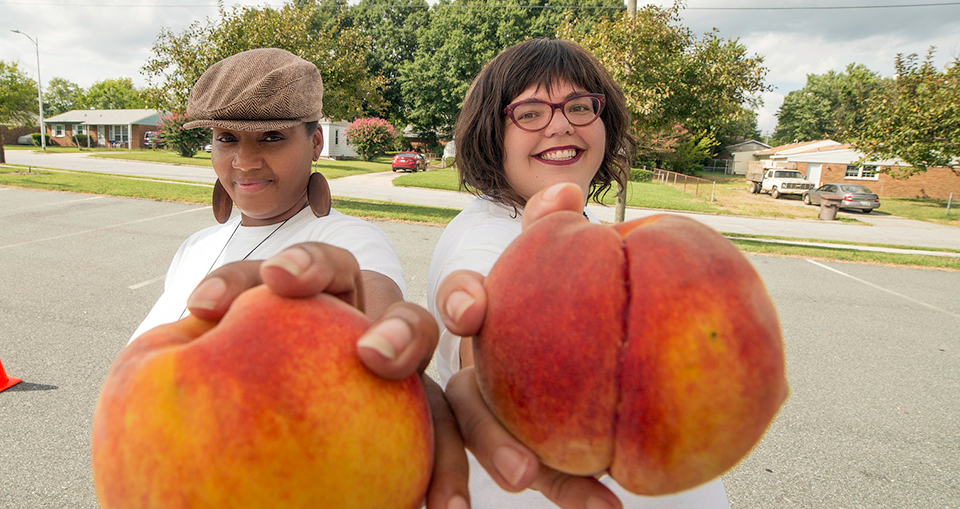
Grocery shopping challenges like Riak’s impact more than immigrants. Two years ago, Greensboro received a startling distinction: Out of the top 100 major metropolitan cities in the U.S., the Greensboro-High Point area ranked number one for residents experiencing “food hardship.”
Food hardship speaks to a person’s financial ability to buy food, explains Marianne LeGreco, associate professor of communication studies. But hardship, she says, isn’t really the whole story.
Dr. LeGreco mobilizes conversations around food, challenging her students and community partners to look at the problem through a wider lens. To truly address issues of hunger and health, she says, we have to look at “food security,” which puts the focus on physical as well as economic access to food, and on issues such as nutrition and education.
“When we talk about food security, we take a broader look at our food systems,” she says. “That helps us implement true, lasting solutions.”
LeGreco is working to increase food security by uniting organizations with shared goals — from university researchers to community organizations to faith-based groups — who are tackling the problem from different angles.
“We didn’t focus solely on food hardship,” she says of the community’s response to its 2015 ranking. “We mobilized people to start paying attention to food deserts and food insecurity in the community — and more.”
Click here to read the rest of “The Harvest at Home” by Robin Sutton Anders, a Fall 2017 UNCG Research magazine feature about how UNCG scholars, including Dr. Marianne LeGreco and Dr. Jigna Dharod, are working with community partners to ensure that we all have what our bodies need: food that’s good for us.
Photography by Mike Dickens