From the Spring 2018 issue of UNCG Research Magazine
When John Z. Kiss was nine years old he stayed up late to watch Neil Armstrong take those first steps onto the surface of the moon and tell the world, “That’s one small step for man, one giant step for mankind.”
“My life is sort of the space era,” says Kiss, a professor of biology and dean of the UNC Greensboro College of Arts and Sciences.
But there’s no way he could have known in 1969 that he would one day do research that could help humans take longer space flights and live on the moon or Mars.
Kiss is not a rocket scientist. But he’s one of a small cadre of space biologists, scientists who study how living systems function beyond the Earth’s atmosphere.
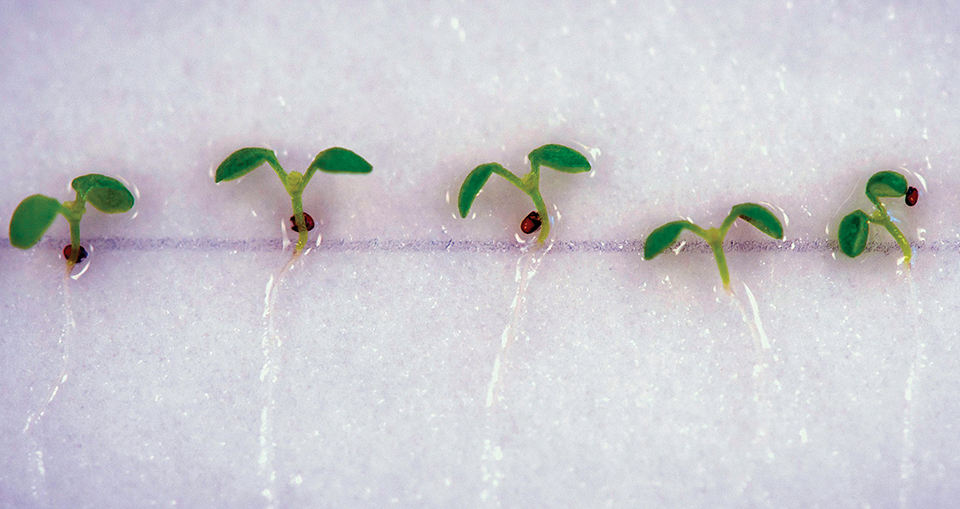
Kiss has devoted more than 25 years to understanding what happens to plants in space. It’s critical work because, as NASA and other space agencies around the world plan for potential bases on the moon, interplanetary flights, and putting humans on Mars, plants will be essential.
In the sealed environment of a spacecraft, space station, or extraterrestrial base, plants could help turn carbon dioxide exhaled by astronauts back into oxygen they can breathe in again. They could also produce food — essential when the nearest grocery store is back on Earth, hundreds of thousands or millions of miles away.
“Everything I’ve done has really been basic research in plants,” Kiss explains. “We pursue basic discoveries, and some of them will have practical benefits in the long term.”
Kiss’ work could also have earthly benefits. By studying how plants respond to the stresses of space, for example, we could gain insights that help us understand how we might help plants adapt to stresses such as climate change here on Earth.
The UNCG biologist has focused on plant physiology and how plants respond to environmental cues. This is an important question for space research, because important plant stimuli, such as gravity and light, can be different off-Earth. Knowing how plants will or won’t grow in those environments is the first step to actually growing plants as part of life support systems in space.
Since 1997, Kiss has led or co-led experiments where plants ride into space on rockets and are then exposed to different environmental stimuli. His most recent extraterrestrial experiment was in the summer of 2017.
Click here to read the rest of “To Boldly Grow” by Mark Tosczak, a Spring 2018 UNCG Research magazine feature.