Redacted from the fall 2016 Research Magazine
Can researching the past help shape the future? Duane Cyrus thinks so.
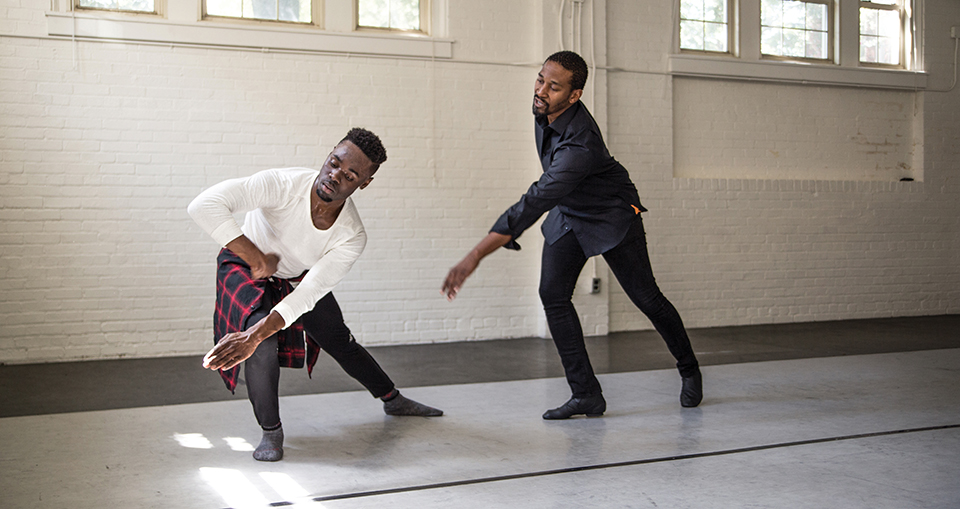
Cyrus, an associate professor of dance, is exploring his uncle’s life-saving heroism in World War II as the basis for a short film and a dance production to be performed at UNCG in September 2017. “Comanche” examines the theme of rescue and, at the same time, showcases a new theory of artistic production.
![The U.S.S. Dorchester [Photo provided by the U.S. Coast Guard Historian's Office]](https://research.uncg.edu/wp-content/uploads/2017/04/DORCHESTER_DOR-PC2.jpg)
![The Comanche [Photo provided by the U.S. Coast Guard Historian's Office]](https://research.uncg.edu/wp-content/uploads/2017/04/Comanche20May1944002.jpg)
As the operation came to a close, David spotted one last man floundering in the frigid water. He dove in and saved the Comanche’s executive officer, Ensign Robert W. Anderson. Anderson had also been rescuing survivors, but he became overwhelmed by hypothermia and could not pull himself to safety. A few days later, David contracted pneumonia from the prolonged exposure and died.
The Coast Guard later commissioned a cutter in Key West, Fla., in David’s name. During the ceremony, Cyrus met Ensign Anderson’s family and was struck by the thought that many of them would not be alive without his uncle’s sacrifice.
“It hits very close to home for me,” Cyrus says. “I realize that, in my own family, there’s someone who made a personal sacrifice to define freedom. That freedom means that I can be a scholar and creative artist and work and travel and share that story with people. In some ways my uncle indirectly rescued me. I see his sacrifice as a symbolic rescue for all of us.”
![Charles W. David Jr. [Photo provided by the U.S. Coast Guard Historian's Office]](https://research.uncg.edu/wp-content/uploads/2017/04/1_Charles-W-David-Jr_Main-1.jpg)
Through this artistic exploration of the past, Cyrus, who has nearly 35 years of dance experience, is also contributing to the future of his art form. A new production method he has developed called “Theatre of Movement” encourages collaboration among a group of contributing artists, rather than a more traditional division of labor among the choreographer, film director, dancers, and designers. Through this method, Cyrus and a team including students Jonathan Garris and Emmanuel Malette have also created a three-minute film on “Comanche.”
Cyrus’ quest has taken him to Cape Charles, Va., New York, and Washington, D.C. Over the course of his research, he has met with a Coast Guard historian and reviewed documents related to his uncle’s service. He has read about African Americans in the military, and he’s conducted interviews with family members and subject matter experts.
In one of those interviews, Cyrus spoke with dance historian John Perpener about the importance of sharing African-American histories. “As John said, ‘If it’s not told, then it doesn’t exist.’”
Learn more at https://vpa.uncg.edu/dance
An in-progress showing of “Comanche” will take place at UNCG on April 5th, 2017. The event, which is free and open to the public, takes place at 7 p.m. at the UNCG Dance Theater.
The showing is part of “An Evening with the Creative Class,” a community series that features presentations on the arts and panels of local and guest artists. Cyrus developed the series to expand awareness about the talented people that help drive the artistic and creative sector of North Carolina’s Piedmont Triad region.