From the Fall 2017 issue of UNCG Research Magazine
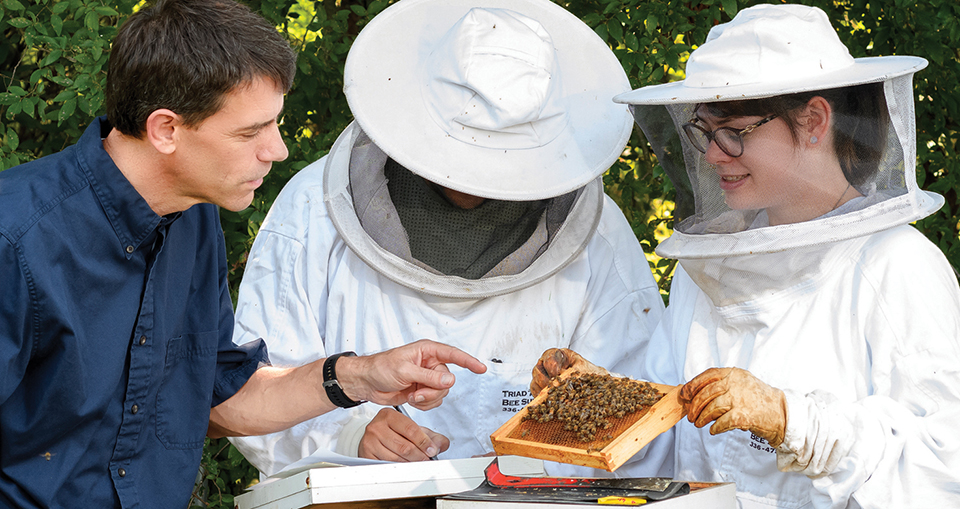
Dozens of young honey bees swirled and buzzed through the air on the warm, late June day. The two undergraduates, though, weren’t sure how to proceed. Collecting bees for research purposes isn’t covered in most classes.
UNCG’s Sara Rubio Correa and Erin Estes, a Northern Michigan University ecology and mathematics major visiting UNCG for the summer Math-Bio Research Experience for Undergraduates program, asked Professor of Biology Olav Rueppell for help. Dr. Rueppell, who runs UNCG’s Social Insect Lab, was happy to demonstrate.
He eschewed the beekeeper’s hood and other protective gear and seemed oblivious to the dozens of bees swirling around him. Young bees like this, it turns out, rarely sting.
Removing a frame of honeycomb from the hive, he gently knocked some of the bees into a plastic funnel. They fell through the funnel into clear plastic cups — the kind you might otherwise use for an iced latte on a day like this.
The two students observed from several feet away.
He moved briskly, and in less than five minutes had collected several cups of bees for the two students to take back to the lab.
The bees were headed inside to be sedated and then studied — all part of PhD student Shilpi Bhatia’s research to better understand if some strains of honey bees are more virus-resistant than others.
The virus resistance project is one of several studies underway in Rueppell’s lab, where he and more than a dozen undergraduate and graduate students are working to better understand how honey bee genetics, behavior, and health fit together. That research could lead to ways to strengthen the health of honey bees, which are critical for our food supply.
Click here to read the rest of “Buzzworthy,” a Fall 2017 Research Magazine feature by Mark Tosczak.
Photography by Martin Kane