Article by Chris Davis, Grant Specialist, Office of Sponsored Programs
No matter how you did in your anatomy classes, if you participate in regular physical activity, you are probably aware of the Anterior Cruciate Ligament, or ACL. The ACL is vital for activities involving jumping or sudden changes of direction. Whether one is a dancer or a soccer player, a professional or recreational athlete, the concern is the same. Injuries to this ligament can mean the end of a season, a passion, or even a livelihood.
Females are at greater risk for ACL injuries. To date, research has identified neuromuscular control patterns thought to increase the risk for an ACL injury, and these patterns are common among female athletes.
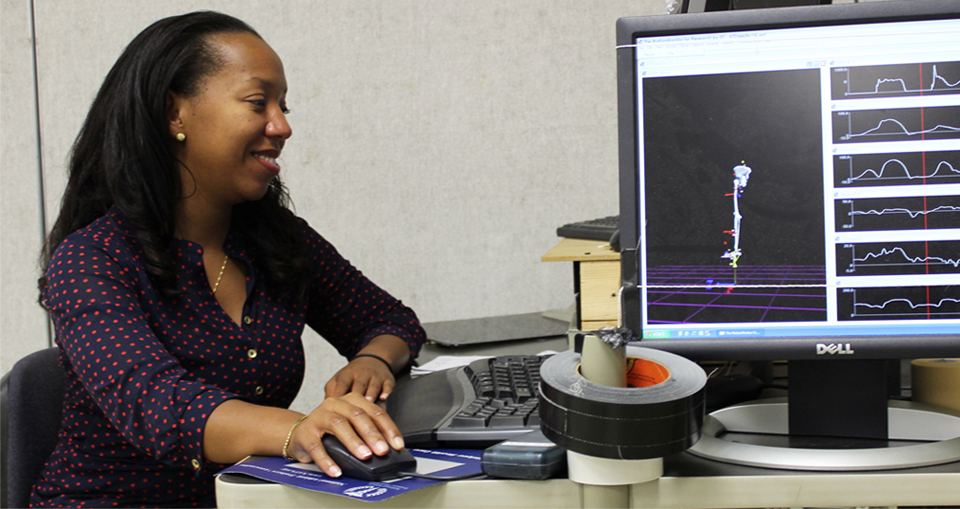
However, UNCG doctoral student Michele Pye has noticed that dancers seem to demonstrate more protective neuromuscular control patterns than other athletes during jumping and change of direction movements. The Department of Kinesiology research assistant specializing in dance medicine observed that female dancers are more stable following a jumping task, land in a more neutrally aligned position, and activate the hamstring musculature significantly faster following an unanticipated perturbation.
No research to date has directly compared the neuromuscular control patterns of females at low and high risk for ACL injury. With a $2,500 grant from the National Athletic Trainers Association (NATA) Research and Education Foundation, Pye plans to change that. Her research will characterize neuromuscular strategies in female dancers and other female athletes during functional tasks to determine if dancers demonstrate more protective strategies.
Neuromuscular training involves practicing movements which protect the ACL upon jumping and landing. This practice conditions the unconscious signals between the brain and the body’s muscles and joints to, in effect, memorize those movements, thus reducing the chances of ACL injury.
Traditional dance practice seems to provide that neuromuscular training to female dancers. Pye says that, on the surface, this approach seems effective. Dancers are 3 to 5 times less likely to injure their ACLs compared to other female athletes. With her research funding, the kinesiology student now sets out to test her hypothesis.
Pye’s approach will compare neuromuscular profiles in female dancers and athletes during an unanticipated perturbation, planned drop landing, and jump stabilization task. Factorial ANOVAs will detect differences between dancers and other athletes on biomechanics (vGRF, knee valgus, knee flexion), muscular activation (onset time, mean peak amplitude), and dynamic postural control (time to stabilization). She will conduct this research under the guidance of her advisor, Dr. Sandra Shultz.
Pye expects that dancers, due to dance training, will demonstrate more protective neuromuscular control patterns. If her hypothesis is true, her research could contribute to the development of an effective neuromuscular training program to prevent ACL injuries.
Article by Chris Davis
Photography by Eun-Ju Seo
Article author Chris Davis is a Grants Specialist with the UNCG Office of Sponsored Programs. He assists faculty (predominantly within the humanities) with pre- and post-award administration. Davis is also a historical writer and researcher. His first book, “How the Grail Became Holy,” was published in 2012.