From the fall 2017 issue of UNCG Research magazine
It started with a rolled ankle during a daily run. That’s when undergraduate Jason Moody first thought about the body’s biomechanics. How did his ankle turn, and what did it mean?
That question ultimately led him to the Department of Kinesiology, where he conducts research with Associate Professor Christopher Rhea and Assistant Professor Anne Brady. But he didn’t take a traditional path.
Moody’s winding journey started in high school, where he played football and wrestled. He wasn’t clear on his career goals, but, when he came to UNCG as a freshman, he decided to major in psychology and minor in theatre. Then, he took a break from school to intern at Walt Disney World, where he honed his communication skills, interacting with a wide variety of people.
But Moody knew Disney wasn’t his destiny. As an avid runner, he shifted his focus to health and exercise, wondering whether he could help others live longer, healthier lives. “I don’t want to work with athletes,” he says. “I want to help older people with everyday activities, their everyday life — to help them be here for their grandchildren.”
When he — literally and figuratively — stumbled into kinesiology, Moody discovered UNCG has one of the strongest and fastest growing departments nationwide. He returned to campus and jumped into undergraduate research.
Now, he works with older adults to improve their physical capabilities and stability. In Dr. Rhea’s lab, Moody partners with graduate researcher Brian Cone to help adults over 75 with trip training — an effort designed for fall prevention.
Falls are a leading cause of injury and death among older Americans, according to
the Centers for Disease Control and Prevention. In 2015, Moody says, the cost related to falls for older adults totaled about $32 billion dollars.
The team is testing whether putting participants through a 15-minute trip-training session can help them alter their walking patterns to avoid falls.
“When we’re kids, we constantly play and control our balance,” explains Moody’s mentor Rhea. “As we get older, one reason we fall more may be because we’re not putting ourselves in these unbalanced, unexpected situations anymore.” Trip training provides those situations.
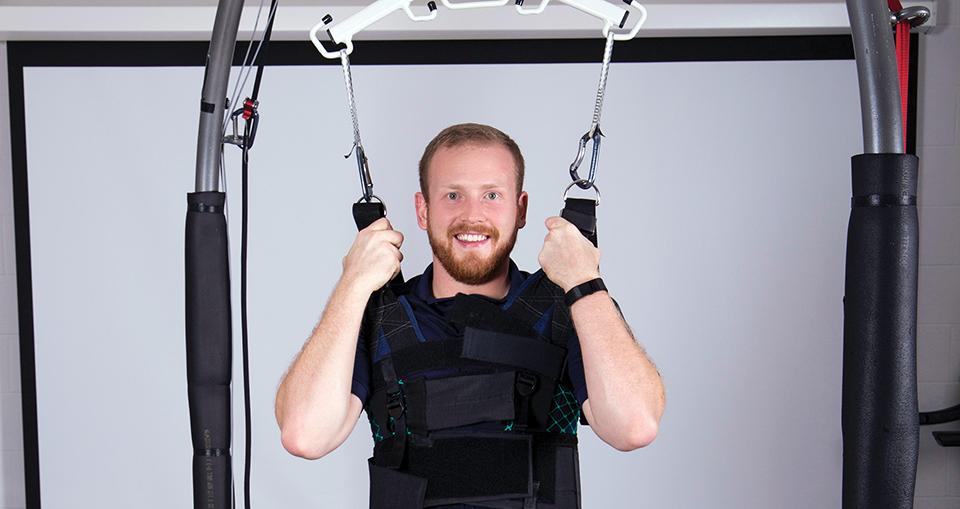
Participants wear safety harnesses and motion-recording sensors. Researchers unexpectedly stop the treadmill eight times, simulating trips, and record data on how participants — unharmed thanks to the harness — recover.
Photography by Mike Dickens