From the Spring 2018 issue of UNCG Research Magazine
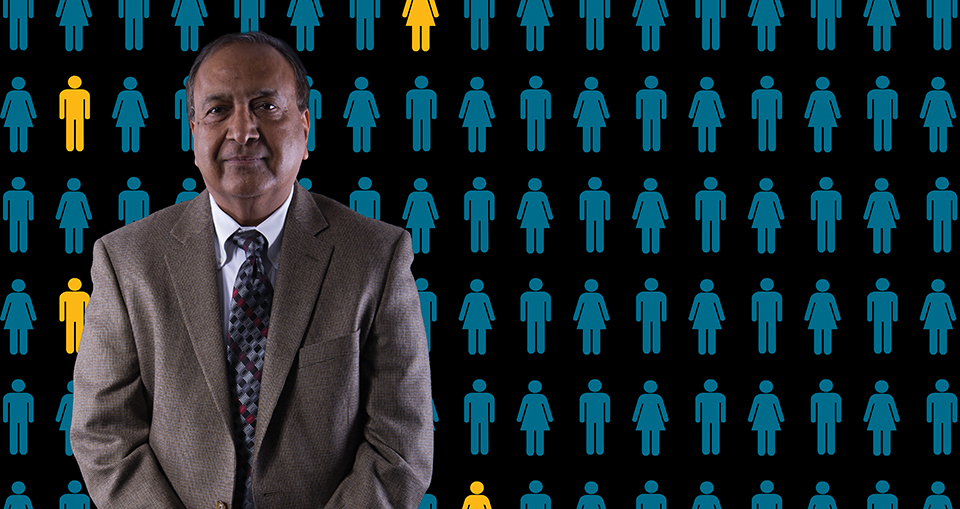
Dr. Sat Gupta is a professor of statistics. With more than 125 journal articles, the Senior Research Excellence Award winner is both an accomplished theoretical researcher and statistical consultant, applying his expertise broadly and collaborating with researchers in disciplines as diverse as biology, education, nutrition, anthropology, economics, public health, psychology, and medicine.
Gupta, who is the founding editor of the Journal of Statistical Theory and Practice, has received funding from agencies such as the National Science Foundation, National Institutes of Health, Mathematical Association of America, and Robert Wood Johnson Foundation. Last year, he was named a Fellow of the American Statistical Association, the highest professional recognition in his field.
Broad Impact
“I’m a statistician. Although my core research at this point is in the branch of statistics called survey sampling, I do non-survey work also — teaching, consulting, and working with researchers in many other disciplines. In recent years, I’ve appeared in many court cases on behalf of the North Carolina Division of Medical Assistance. In these cases, I basically explain to judges why the sampling approach the State is using is reasonable and based on proper statistical techniques.”
Estimating Sensitive Human Behaviors
“The biggest impact I’ve had would be the introduction of optional RRT models. That, I suppose, will be my legacy. The term RRT means ‘randomized response technique.’ In this technique, in a survey question, you have respondents give you a randomized response, or a scrambled response, rather than a straightforward response. Why would you do that? Well, the survey question could be so personal that if you ask the respondent to give you a correct, emphatic response face-to-face, they may refuse to answer — which is bad enough— or worse still, they may give you a socially acceptable lie. Think: ‘Have you ever cheated on taxes?’ My breakthrough work on this appeared in the Journal of Statistical Planning and Inference in 2002. It established optional RRT, where survey participants have an additional choice of providing an accurate, non-scrambled response if they don’t find the research question embarrassing.”
A Breakthrough for Greater Accuracy
“With optional RRT, a researcher will not know if a particular participant provided an unscrambled response. However, the pool of survey answers now contains unscrambled responses as well as scrambled responses, which, with correct modeling, allows the researcher to estimate the average response to the research question with greater accuracy. There’s better precision. I’ve written many papers related to it. All my PhD students, by and large, have worked on optional RRT models. It opened up a new area of research, not only for my students but for many other researchers. We have shown that these optional models can be used in the field and that they work very well. With any RRT model you can think of, there is going to be an advantage in using the optional version of that model.“
Real-World Applications
“I enjoy collaborating. For example, I did a study with nurse researchers at Cone Health that won the Association of periOperative Registered Nurses Journal Writers Contest award in 2017. That study was about patients who develop bedsores after surgery. Another recent one was with the School of Nursing, looking at the negative impact of presentism on patient care and the economy. Now we all know what absenteeism is. You are absent from work. But presentism is: you are present at work, but you’re not really working. Maybe you’re in pain or experiencing depression. Nurses who are suffering with depression or pain often end up making mistakes. Baseline cost estimates indicate the increased falls and medication errors caused by presenteeism cost $1,346 per North Carolina registered nurse and just under $2 billion for the United States each year.
“That joy in collaborating extends to my work with graduate and undergraduate students. Undergraduates don’t have to do research, so motivating them to do that work is particularly satisfying. My undergraduates have published RRT papers about stimulant use among college students, STD prevalence, and more. Many have gone on to graduate work, both here with me and at other outstanding programs across the country. One of the most rewarding things is seeing these students progress in life.
“I also enjoy consulting. In one case, I represented a biotech company whose product was rejected by the FDA. We convinced the FDA the approach they used to test compliance of certain diagnostics devices needed modification.”