From the spring 2017 UNCG Research Magazine
Memories are subject to change, just as anyone comparing childhood stories with a sibling or arguing about past events with a significant other knows. The way we respond to our memories varies, too, says Blair Wisco, assistant professor of psychology. She gives the example of an Iraq War veteran suffering from post-traumatic stress disorder.
“He may be struggling with vivid memories of a trauma, like the death of a fellow service member. In therapy the veteran might tell his psychologist exactly what the roadside improvised-explosive device looked like,” she says. He might detail the landscape and describe how his friend fought for his life. Ideally, each time he talks about the memory in his therapist’s office, it will bother him a little bit less.
 “But if that same veteran, driving down the road, were to see a discarded trash bag resembling an IED, he might experience an entirely different — possibly much stronger — emotional response in that setting,” Dr. Wisco explains. And unless psychologists have a tool to measure that real-world response, they have no definitive way to track the progress of their PTSD treatment.
In a recent pilot study funded by a UNCG Faculty First grant, Wisco has introduced an innovative new method for monitoring a patient’s physiological reactions to trauma memories.
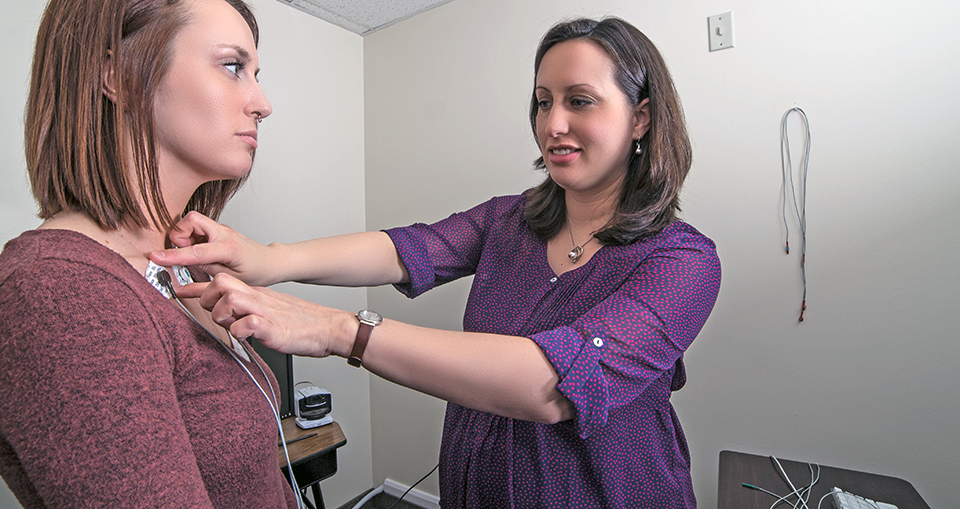
Veterans diagnosed with PTSD wear ambulatory heart monitors, which track their fight-or-flight responses 24 hours a day for three days in a row. These participants carry an iPad with them, and at random, frequent intervals throughout the day, they’re prompted to answer a quick survey on whether or not they are thinking about their trauma. They also rate the intensity of their emotions.
Looking at data from their heart monitors, Wisco can examine participants’ physiological arousal throughout the day. “We know that, in the lab, participants with PTSD show strong physical reactions when they are thinking about their trauma,” Wisco says. “But this has never been tested in a naturalistic environment.”
![[Photo by Mike Dickens]](https://research.uncg.edu/wp-content/uploads/2017/06/Computer.jpg)
Also, the use of ambulatory heart monitors is more ecologically valid. In other words, “we are actually measuring patients’ symptoms as they experience them instead of asking at the end of the week when people have a hard time remembering,” Wisco explains.
Wisco plans to conduct in-depth follow-up studies, collaborating with colleagues in biology and nanoscience. Ambulatory heart monitors might help match patients with specific types of treatment. “Up to a third of people who receive the best treatments still have PTSD,” Wisco says. “There is a lot of room for improvement with existing therapies, and this technology could help doctors identify what’s right for their patients.”
“Rewire” by Robin Sutton Anders originally appeared in the spring 2017 UNCG Research Magazine.