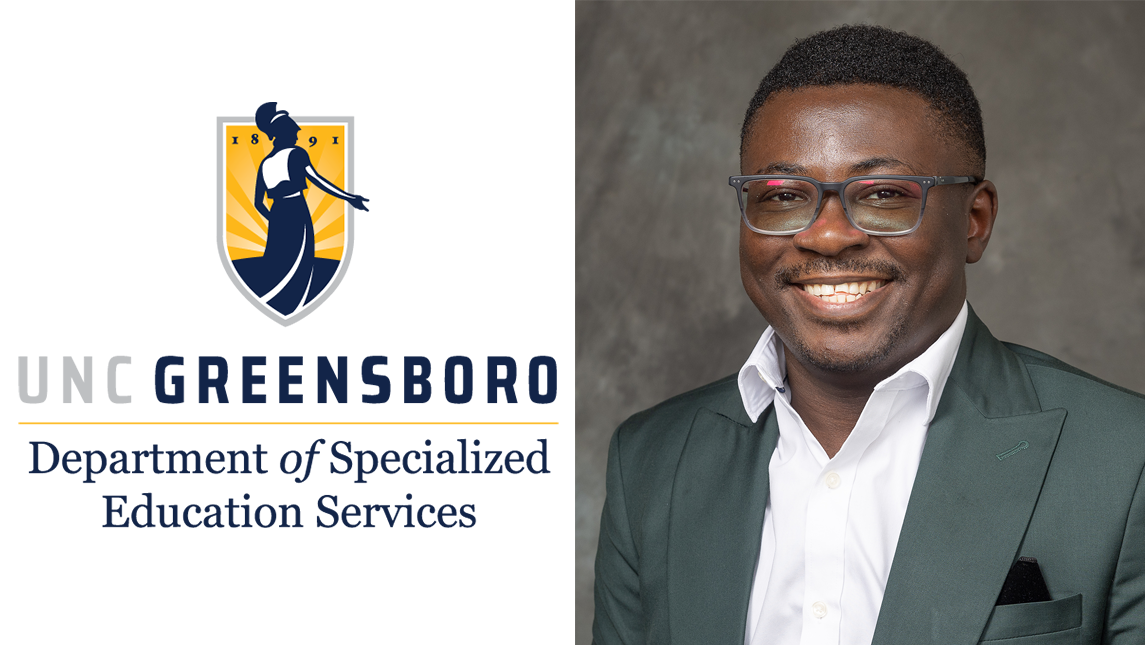
Dr. Tolulope Sulaimon serves as an assistant professor in the Department of Specialized Education Services.
What is your educational background?
I earned my bachelor’s degree in Educational Administration from the University of Lagos in Nigeria, where I also obtained a teaching license in English and religious studies. After working as an internal auditor at a school, I transitioned into special education and completed several professional certifications in the field. This shift led me to pursue graduate studies in the United States. I earned my master’s degree in special education from Cleveland State University and later completed my Ph.D. in Special Education at The Ohio State University, with a concentration in applied behavior analysis and high-incidence disabilities. I then proceeded for my post-doc at the University of Central Florida, where I worked on a federally funded grant.
Why did you choose to come to UNCG?
Teaching really comes first for me. I enjoy research, but I wanted a place where I could balance both and stay closely involved in teaching and in training teachers. That part really mattered to me. The city was also a big factor, and my wife loved it too. Beyond that, the sense of community stood out. There is a lot of collaboration within the School of Education. You can approach anyone with an idea or a question, and people are genuinely open and willing to work with you.
What are your current research interests and what attracted you to those areas?
My current research interests focus on reading comprehension, particularly as it relates to mathematics word problem solving and the use of technology to support students with learning difficulties. This interest grew out of my experience as a math intervention specialist in Nigeria. Many of my students were proficient in arithmetic, yet they consistently struggled with word problems. That experience helped me realize that the challenge was not just mathematical skill, but comprehension of problem contexts.
At the same time, I was not exposed to the kinds of assistive technologies I later encountered during my graduate training in the United States, particularly while working as a graduate assistant with the Office of Disability Services at Cleveland State University. There, I saw how assistive technology could be intentionally integrated with evidence-based instructional strategies to better support students. Tools such as text to speech significantly improved students’ access to content and their overall engagement.
More recently, my work has expanded into the use of artificial intelligence to support comprehension instruction. I have developed a comprehension focused AI instructional tool designed to improve students’ reading comprehension through personalized support based on individual reading levels and responses. This work has been submitted for external grant funding, and my goal moving forward is to scale the tool so it can be widely used by educators and students.
What are you hoping to accomplish with Your Research?
What I hope to accomplish with my research is to make comprehension instruction accessible to every student and to improve the fidelity with which evidence-based comprehension instructional strategies are implemented. I recognize that this is not a failure on the part of teachers. Students have diverse needs, and meeting those needs consistently is challenging in real classrooms. My goal is to use AI supported instructional tools to help bridge that gap, so teachers can reach more students effectively, and so students can continue learning even outside the classroom. Ultimately, I want every student, including those without consistent instructional support, to have access to high quality comprehension instruction.
How do students assist with your research?
Currently, I am working with four students. Most of them work with me as observers, helping check the fidelity of my work, and I also give them opportunities to contribute to different sections of the paper. Recently, a prospective student for our Ph.D. program reached out to me about working together. She contacted me because she noticed that our research interests align, even though she has never done this kind of work before. I am guiding her through the process and helping her build those skills. I see that as part of my responsibility. That is how students grow. I benefited from that kind of mentorship myself. I also make it a point to reach out to students when I am working on a project, so they know there is an opportunity to get involved if they are interested.
What advice would you give people who are Considering GOING into THIS FIELD OF Work?
My advice would be to be proactive and intentional about building connections. Reach out to people, ask questions, and seek out mentors early. I would also strongly encourage students to spend time in the field. Because our work is applied and data driven, being in real classrooms and school settings helps you understand what truly interests you and the kinds of questions you want to pursue through research. Partnering with communities and working directly in schools gives you clarity and direction, and it allows you to focus on a specific area of special education that you are most passionate about.
What do you enjoy outside of work?
I enjoy music. I love the news. I love watching and playing soccer. I enjoy spending time with my daughter. I love reading with her. It’s fun to see her read. That’s one of the things that relaxes me.
If you were given $1 million to use on your research, what impact would that make?
With one million dollars, I would invest in developing an AI based instructional tool that is free and accessible to parents and students. Many of the tools that support reading cost some dollars, and the students who need them most are often from low-income families who cannot afford those resources. I would use the funding to build a high quality, research-based tool that removes cost as a barrier and ensures equitable access to effective reading instruction. The goal would be to make high quality comprehension support available to everyone, regardless of background or setting.
The post Meet the Researcher: Dr. Tolulope Sulaimon appeared first on School of Education.

